










アプリケーションノート
・Hydrogen Desorption (TDS) in SiNx Thin Films using ESCO-TDS1200II IR
Using an infrared-heating TDS system (Model: ESCO-TDS1200II IR), we evaluated hydrogen desorption in SiNx thin films. Three H2 desorption peaks were observed at 450 °C, 570 °C, and 980 °C. The low-temperature peaks are consistent with surface-origin species on the native oxide (H2O or H), whereas the high-temperature peak reflects bulk hydrogen (N–H and Si–H). These results provide actionable guidance for pre-clean, deposition, and annealing optimization.
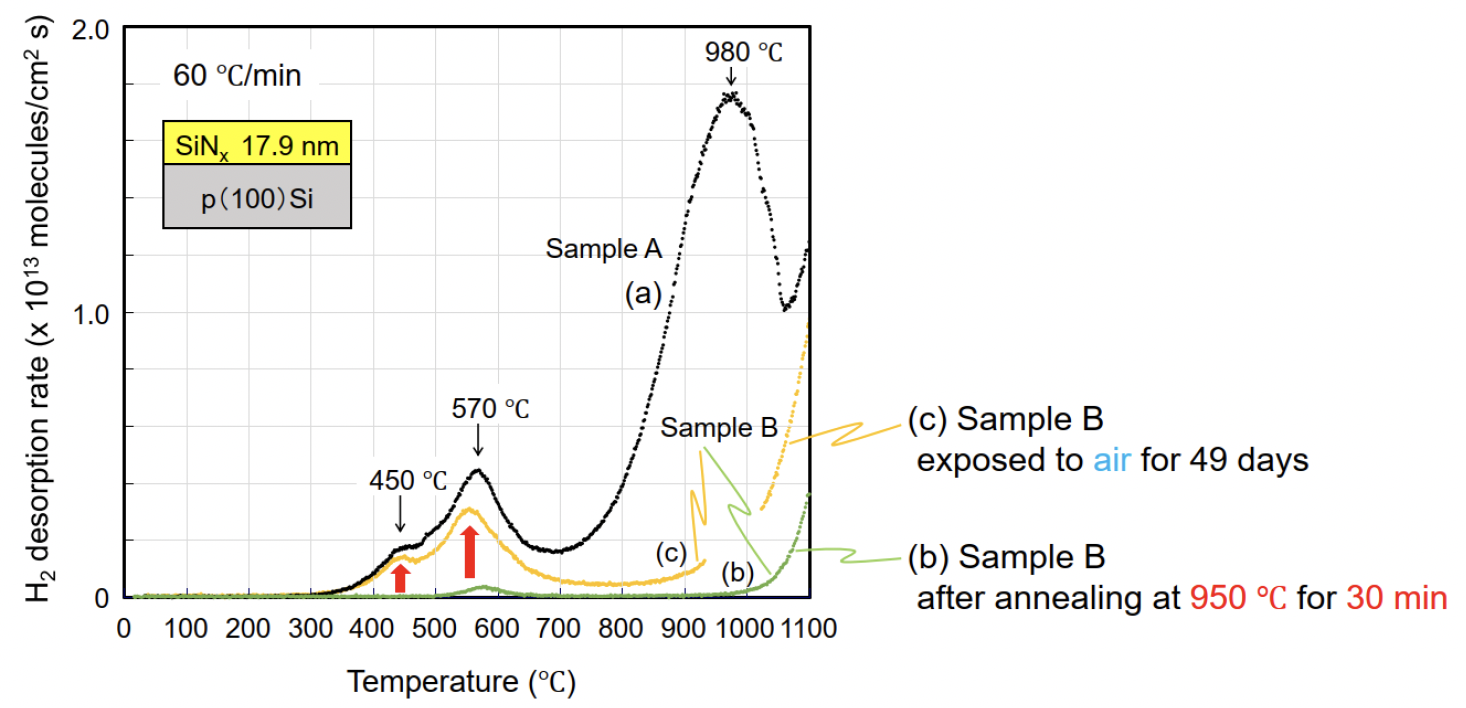
Fig. TDS spectra of H2 molecules obtained from samples A and B.
Low-temperature regime (450 °C and 570 °C) — Surface-origin desorption
High-temperature regime (around 980 °C) — Bulk-bonded hydrogen in SiNₓ
For additional technical details, please visit the Technical Note below.
⇒AppricationNote_TDS_SiNx_EN_20251114v5.pdf ※A PDF file (504kb) will open.

・Hydrogen Desorption under an Anneal-like Temperature Profile in SiNₓ Thin Films using ESCO-TDS1200II IR
Using the ESCO-TDS1200II IR, we measured hydrogen release from SiNₓ thin films under a program similar to a common annealing furnace: a 10 °C/min ramp to 950 °C, followed by a 30-minute isothermal hold. Three H₂ peaks appear during heating, and the desorption rate falls steadily during the hold; about 65% of the total release occurs during the ramp.
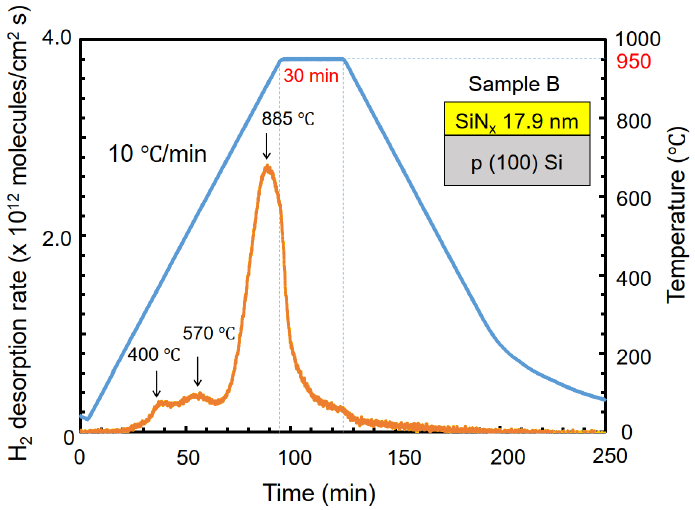
Fig. 1 During the heating segment, three well-resolved H₂-desorption peaks emerged as the temperature increased.
During the isothermal segment at 950 °C, the H₂-desorption rate decayed smoothly and monotonically with time.
For additional technical details, please visit the Technical Note below
⇒AppricationNote_TDS_SiNx_EN_20251215v2.pdf ※A PDF file (483kb) will open.
お問い合わせ
製品についてご相談・ご質問等ございましたら、
以下のお問い合わせフォームより、お気軽にお問い合わせください。
